
Introduction
Buying property in and around Bengaluru can feel overwhelming, especially when terms like “land,” “plot,” “site,” and “plotted development” get thrown around. Many first-time buyers and investors I speak with get confused—aren’t they all the same thing?
Not quite. Understanding the real difference can save you lakhs of rupees, years of legal headaches, and sleepless nights. In simple words: Land is the raw, undeveloped piece of earth. A plotted development is that same land, but properly divided, approved, and made ready for you to build or invest with much lower risk.
Let me break it down for you in plain language, with real-life examples relevant to North Bengaluru and Karnataka.
What is “Land” in Real Estate Terms?
When people say “land,” they usually mean a larger, often raw or semi-developed piece of property. In Karnataka, this is frequently:
- Agricultural land (still shown as farmland in revenue records)
- Revenue land/sites (agricultural land informally divided and sold without full approvals)
- Large undivided parcels waiting for future development
Pros of buying raw land:
- Usually much cheaper per square foot
- High potential for long-term appreciation if the area grows
- More flexible in size (you can buy acres)
Cons (and they are big):
- You cannot legally construct a house without converting the land use (from agricultural to non-agricultural/residential)
- Higher risk of title disputes, encroachment, or missing documents
- No proper roads, electricity, water lines, or drainage in many cases
- Banks are hesitant to give home loans on unconverted land
In short, raw land is like buying a beautiful empty canvas—you have total freedom, but you also have to do all the hard work (and bear all the risk) yourself.
What is a “Plotted Development”?
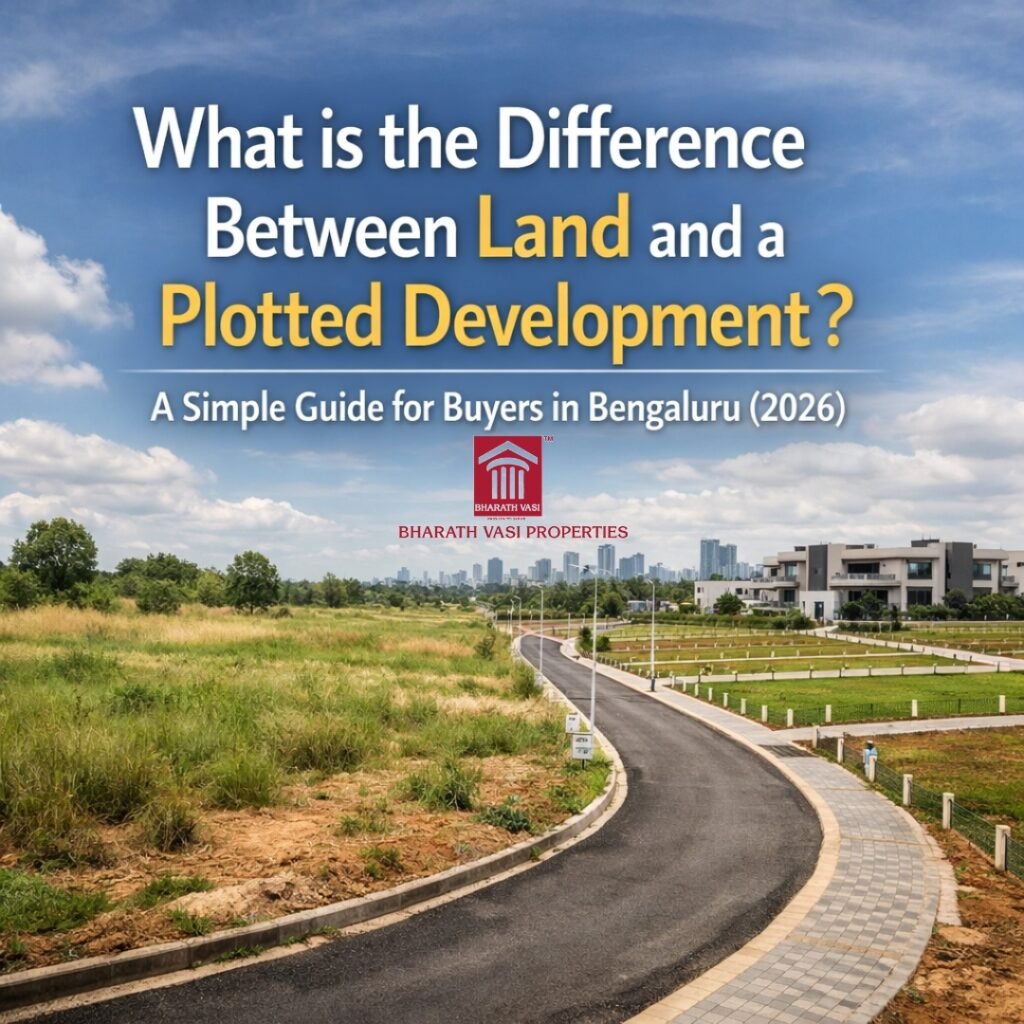
A plotted development (also called a plotted layout or approved layout) is when a developer or authority takes a piece of land, gets all the necessary approvals, divides it into smaller, clearly marked individual plots, and provides basic infrastructure.
Think of it as a ready-to-build residential neighborhood where each buyer owns their own plot outright.
Key features of a good plotted development:
- Proper layout approval from BDA, BMRDA, DTCP, or Gram Panchayat (depending on location)
- Land conversion done legally (DC Converted or better)
- Internal roads, street lights, drainage, and often water & electricity connections
- Clear boundaries with survey stones or fencing
- Individual A-Khata in many cases
- RERA registration (increasingly common for bigger projects)
You still buy the land and can design and build your dream house (or villa) exactly the way you want. But the heavy lifting—legal clearances and basic infra—has already been done.
Land vs Plotted Development: Side-by-Side Comparison
| Aspect | Raw Land / Revenue Land | Plotted Development |
|---|---|---|
| Legal Status | Often agricultural or partially converted | Fully converted + layout approved |
| Construction | Not allowed without further approvals | Can start building after building plan approval |
| Infrastructure | Usually none or minimal | Roads, drainage, electricity, water |
| Risk Level | High (title, conversion issues) | Much lower if approvals are genuine |
| Price | Lower | Higher (but includes value of approvals) |
| Loan Availability | Difficult | Easier (especially on approved plots) |
| Appreciation | Slower initially, can be high later | Faster and more predictable |
| Liquidity (Resale) | Lower | Higher |
| Best For | Long-term investors with patience | End-users + smart investors wanting balance |
Why Most Buyers in North Bengaluru Prefer Plotted Developments in 2026
With Bengaluru’s expansion towards Devanahalli, Doddaballapur, and other northern corridors, plotted developments have become extremely popular. They strike the perfect balance—you still enjoy the high appreciation of land, but with far fewer headaches than raw agricultural land.
If you’re someone who wants to build your own home eventually or simply park money in real estate for 5–10 years, a well-chosen plotted development usually offers better peace of mind and returns.
That said, not all plotted developments are equal. Some have solid approvals while others cut corners. Always verify the difference between DTCP-approved, BMRDA-approved, and ordinary layouts before you decide.
Related Reads from Bharath Vasi Properties
If you’re exploring plots near Bangalore, here are a few guides that dive deeper:
- Wondering whether buying a plot on the outskirts makes sense this year? Check out: Is Buying a Plot Near Bangalore Worth It in 2026?
- Curious how changing work patterns are shaping property values outside the city? Read: How Does Remote Work Affect Property Prices in Small Towns?
- Want to understand approvals in North Bangalore better? Don’t miss: DTCP Approved vs BMRDA Approved vs Ordinary Layouts – Which is Safer for Plot Buyers in North Bangalore?
Conclusion
At the end of the day, land gives you potential, while a plotted development gives you clarity and control with reduced risk. For most families and investors in today’s Bengaluru market, a properly approved plotted development offers the sweetest spot—land ownership benefits without the usual nightmares of raw land.
Before you put your hard-earned money anywhere, always do thorough due diligence or consult an experienced local advisor. A small mistake in choosing the wrong type can cost you dearly in time and money.
At Bharath Vasi Properties, we help buyers navigate these exact differences every day. Whether you’re looking for a safe plotted investment in North Bengaluru or want help verifying approvals, we’re here to make the process transparent and stress-free.
Have questions about a specific project or location? Feel free to reach out—we’d love to help you make a confident decision in 2026.
Ready to explore plotted developments that actually deliver? Drop us a message or call us today.